First Meeting · · 6 min read
“Your Price Is Too High”: Handling Solar Price Objections in the First Meeting with a 3D Solar Draft
When a customer says your price is too high, they usually mean they don’t yet see why your system is worth more than the cheaper one.
This article is part of our series How to Close Solar Deals in the First Meeting. It covers one of the most common challenges Indian EPCs face — and how a 3D solar draft, built during the meeting, helps you solve it before you leave.

The challenge
A cheaper quote may use fewer panels, ignore shading, or promise generation it can’t deliver. But on paper, the customer only sees two prices.
Without evidence, you’re forced to either discount or lose the deal.
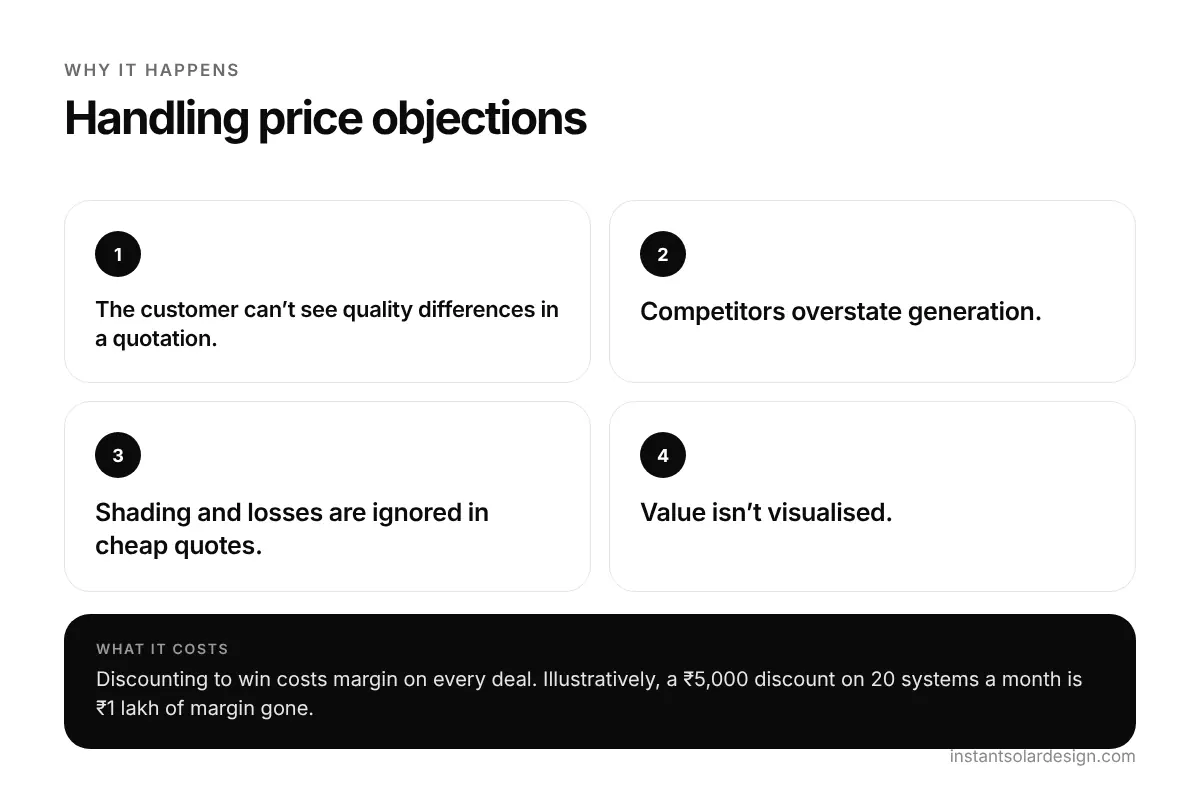
Why it happens
- The customer can’t see quality differences in a quotation.
- Competitors overstate generation.
- Shading and losses are ignored in cheap quotes.
- Value isn’t visualised.
What it costs your EPC
Discounting to win costs margin on every deal. Illustratively, a ₹5,000 discount on 20 systems a month is ₹1 lakh of margin gone.
How a 3D solar draft solves it in the first meeting
Show why your layout is right: where the shadow falls, how losses are calculated and what the realistic generation is. Value you can see is value you don’t have to discount.
- Losses calculated while designing — show the real numbers.
- 30+ obstructions to prove shading was considered.
- Energy report to compare against over-promised quotes.
- Add your own premium panels directly to show their impact.
A shadow analysis and energy report from tools such as SolarDraft or Solar Designer gives you that evidence on screen.
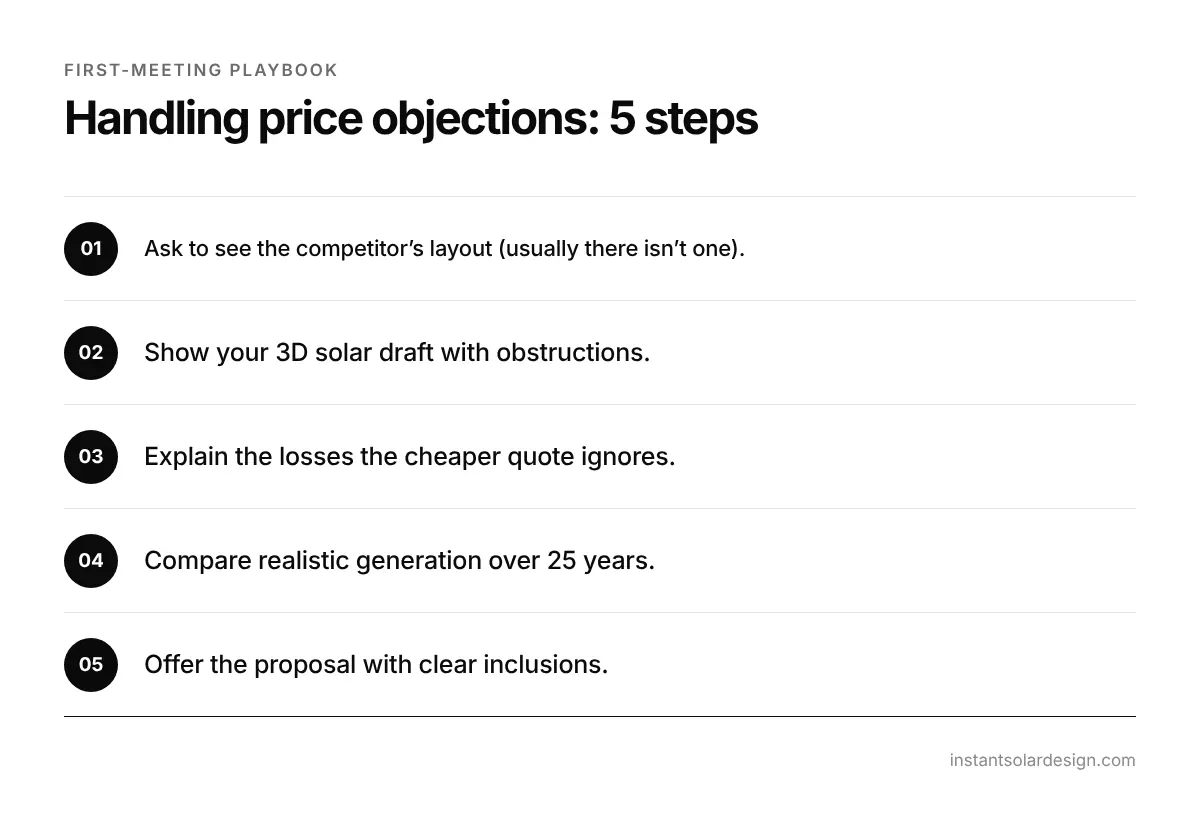
First-meeting playbook: 5 steps
- Ask to see the competitor’s layout (usually there isn’t one).
- Show your 3D solar draft with obstructions.
- Explain the losses the cheaper quote ignores.
- Compare realistic generation over 25 years.
- Offer the proposal with clear inclusions.
Never argue about price. Show the roof, show the shadow, show the numbers — then let the customer decide.
Solar draft vs traditional first meeting
| Traditional first meeting | With a 3D solar draft | |
|---|---|---|
| What the customer sees | Brochure & price list | Their own roof in 3D |
| Energy estimate | Rule of thumb | Energy report with losses |
| Proposal | Sent 2–3 days later | Built in the meeting |
| Absent decision makers | Hear it second-hand | Open the 3D link |
| Typical outcome | “Let me think about it” | Decision today |
Related reading
- The complete first-meeting playbook for solar EPCs
- Your Competitor Quoted the Same Day: How to Win Solar Deals in the First Meeting
- Customers Don’t Believe Your Solar Savings? Build Trust in the First Meeting with a Transparent Solar Draft
- Best Solar Design Software in India (2026): SolarDraft, Solar Designer, Arka360, SolarLadder, Reslink & SurgePV Compared
Need the design done for you?
Send the site — get a 3D design back in 24 hours.
Instant Solar Design delivers white-labelled 3D models, shadow analysis and generation reports from ₹500 per project.
Order a design →Frequently asked questions
How do I handle “your price is too high” in solar sales?
Shift the conversation to value: show the 3D layout, shading and realistic generation that justify your price.
Why are some solar quotes much cheaper?
They may use fewer or lower-quality components, ignore shading or overstate generation.
Can design software show loss calculations?
Yes — good tools calculate losses while you design and include them in the energy report.