First Meeting · · 6 min read
Customers Don’t Believe Your Solar Savings? Build Trust in the First Meeting with a Transparent Solar Draft
“Every installer says I’ll save thousands.” Customers have heard the savings pitch before — and they don’t believe it until they see how it was calculated.
This article is part of our series How to Close Solar Deals in the First Meeting. It covers one of the most common challenges Indian EPCs face — and how a 3D solar draft, built during the meeting, helps you solve it before you leave.

The challenge
Savings are the main reason people buy solar, yet they are the part of the pitch customers trust least. Round numbers on a slide look like marketing.
If the customer doesn’t trust the savings, they won’t sign today.
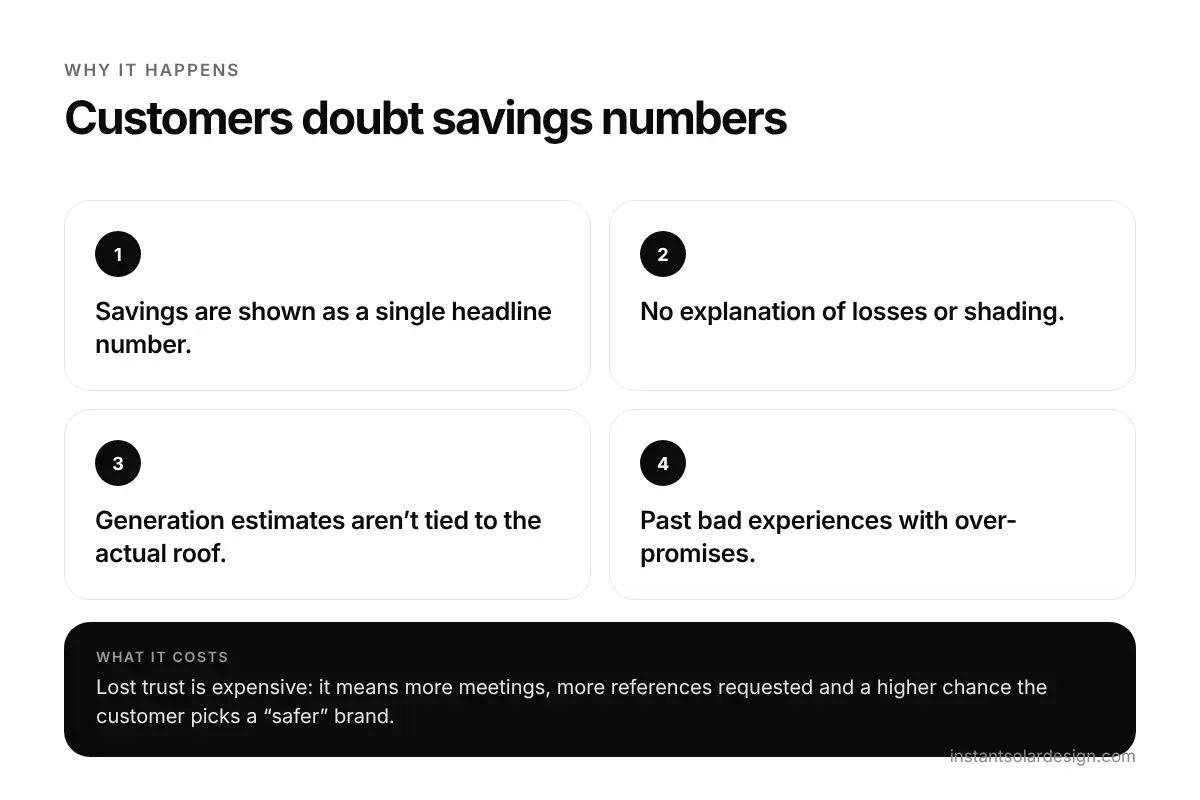
Why it happens
- Savings are shown as a single headline number.
- No explanation of losses or shading.
- Generation estimates aren’t tied to the actual roof.
- Past bad experiences with over-promises.
What it costs your EPC
Lost trust is expensive: it means more meetings, more references requested and a higher chance the customer picks a “safer” brand.
How a 3D solar draft solves it in the first meeting
Tie the energy estimate to the 3D model of the customer’s roof and show losses as you design, so the customer sees where the savings number comes from.
- Live loss calculation during design.
- 3D design report with energy report.
- Obstruction modelling for realistic shading.
- Shareable link so the customer can review later.
Combined design and energy reports are built into tools like SolarDraft and Solar Designer, which keeps the layout and the savings figure in one document the customer can check.
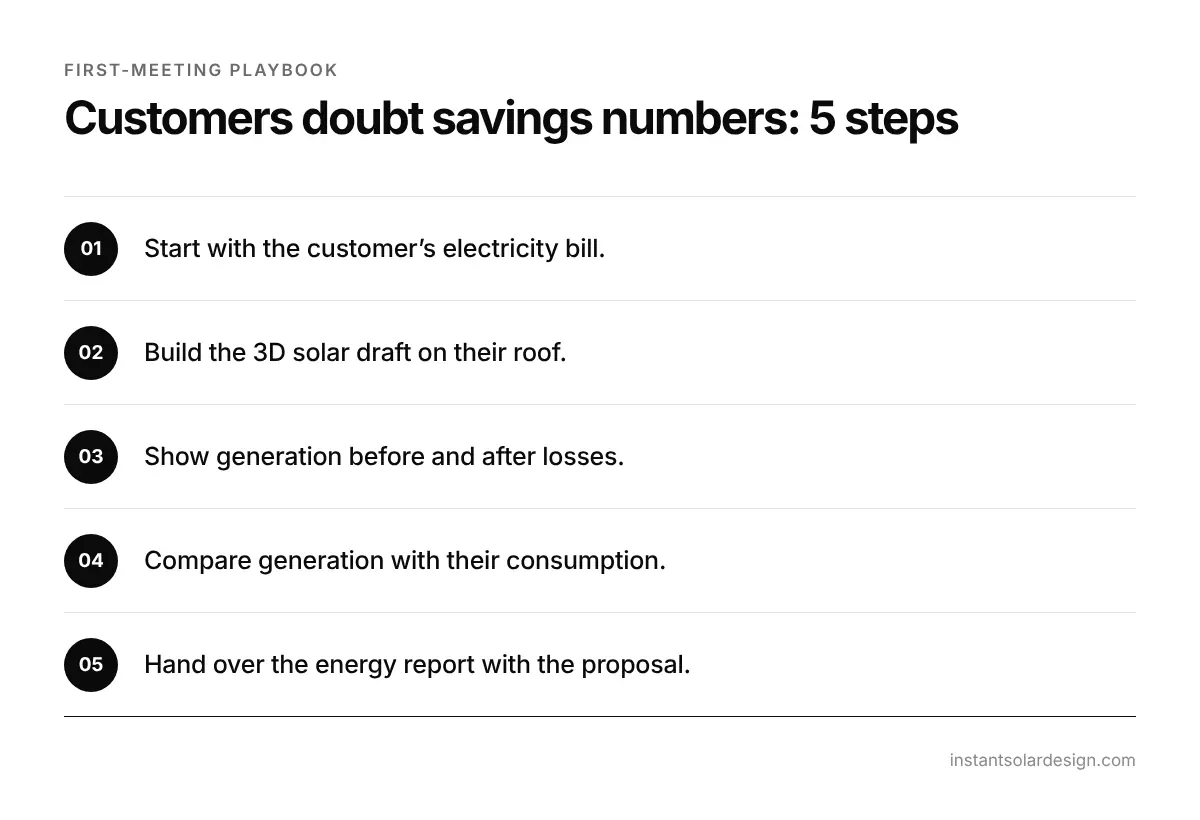
First-meeting playbook: 5 steps
- Start with the customer’s electricity bill.
- Build the 3D solar draft on their roof.
- Show generation before and after losses.
- Compare generation with their consumption.
- Hand over the energy report with the proposal.
Under-promise slightly. A realistic number the customer believes closes faster than a big number they doubt.
Solar draft vs traditional first meeting
| Traditional first meeting | With a 3D solar draft | |
|---|---|---|
| What the customer sees | Brochure & price list | Their own roof in 3D |
| Energy estimate | Rule of thumb | Energy report with losses |
| Proposal | Sent 2–3 days later | Built in the meeting |
| Absent decision makers | Hear it second-hand | Open the 3D link |
| Typical outcome | “Let me think about it” | Decision today |
Related reading
- The complete first-meeting playbook for solar EPCs
- “Your Price Is Too High”: Handling Solar Price Objections in the First Meeting with a 3D Solar Draft
- “What About the Shadow From Next Door?” Solving Shading Doubts in the First Meeting
- Best Solar Design Software in India (2026): SolarDraft, Solar Designer, Arka360, SolarLadder, Reslink & SurgePV Compared
Need the design done for you?
Send the site — get a 3D design back in 24 hours.
Instant Solar Design delivers white-labelled 3D models, shadow analysis and generation reports from ₹500 per project.
Order a design →Frequently asked questions
How can I make solar savings believable?
Link savings to a roof-specific design and show losses transparently.
What losses should be shown to customers?
Shading, temperature and system losses — ideally calculated from the actual 3D layout rather than a fixed percentage.
Which tools create a combined design and energy report?
Most rooftop design platforms do. In India, SolarDraft and Solar Designer produce a 3D design report with an energy report in one PDF.