First Meeting · · 6 min read
“What About the Shadow From Next Door?” Solving Shading Doubts in the First Meeting
In dense Indian neighbourhoods, almost every roof has something that casts a shadow. Customers know it — and it makes them hesitate.
This article is part of our series How to Close Solar Deals in the First Meeting. It covers one of the most common challenges Indian EPCs face — and how a 3D solar draft, built during the meeting, helps you solve it before you leave.

The challenge
A tall neighbouring building, a coconut tree, a water tank on the mumty — customers worry their panels will sit in shade half the day. If you just say “it will be fine”, they don’t believe you.
Unanswered shading concerns are one of the main reasons for a second site visit.
Why it happens
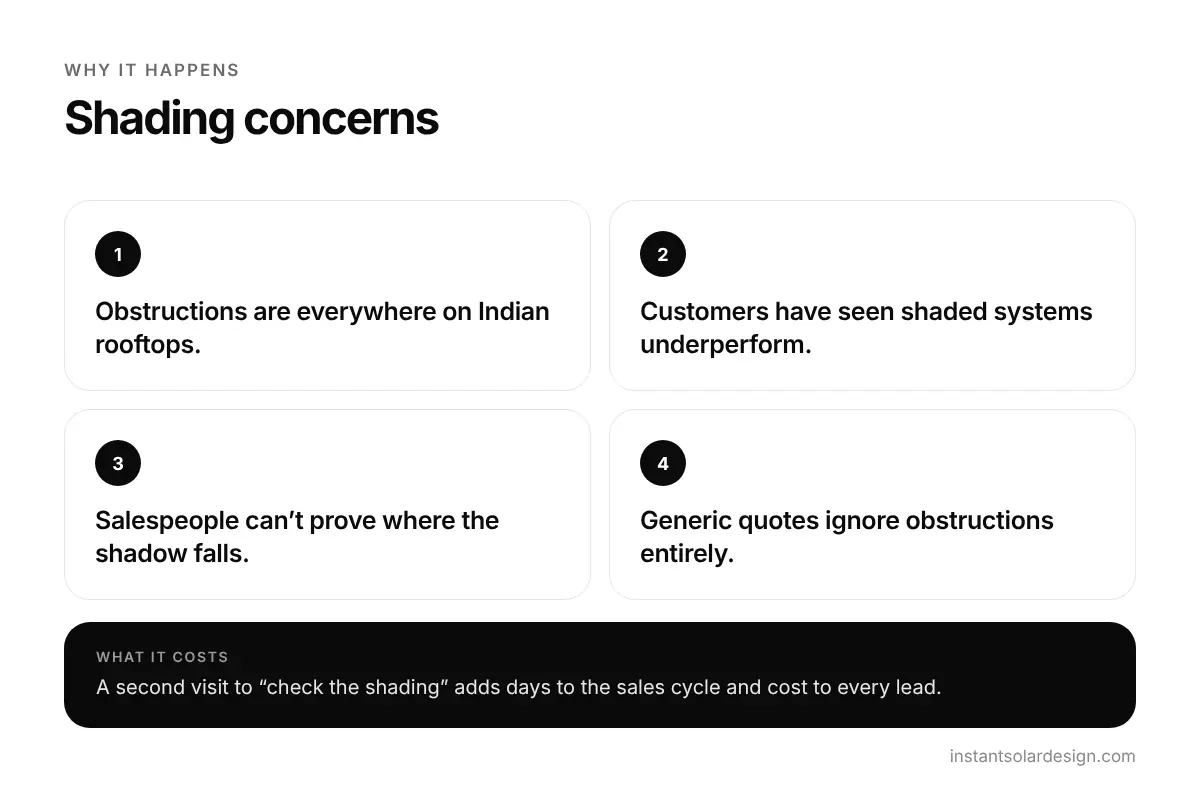
- Obstructions are everywhere on Indian rooftops.
- Customers have seen shaded systems underperform.
- Salespeople can’t prove where the shadow falls.
- Generic quotes ignore obstructions entirely.
What it costs your EPC
A second visit to “check the shading” adds days to the sales cycle and cost to every lead.
How a 3D solar draft solves it in the first meeting
Model every obstruction — trees, mumty, elevated roofs, water tanks and HVAC — and calculate losses while you design. Then move panels away from the shadow in front of the customer.
- 30+ obstruction types including trees, tanks and HVAC.
- Losses calculated while designing.
- One-click fill that respects obstructions.
- 3D view the customer can rotate.
Advanced shadow analysis is included in every SolarDraft plan, and Solar Designer offers the same obstruction-aware layout.
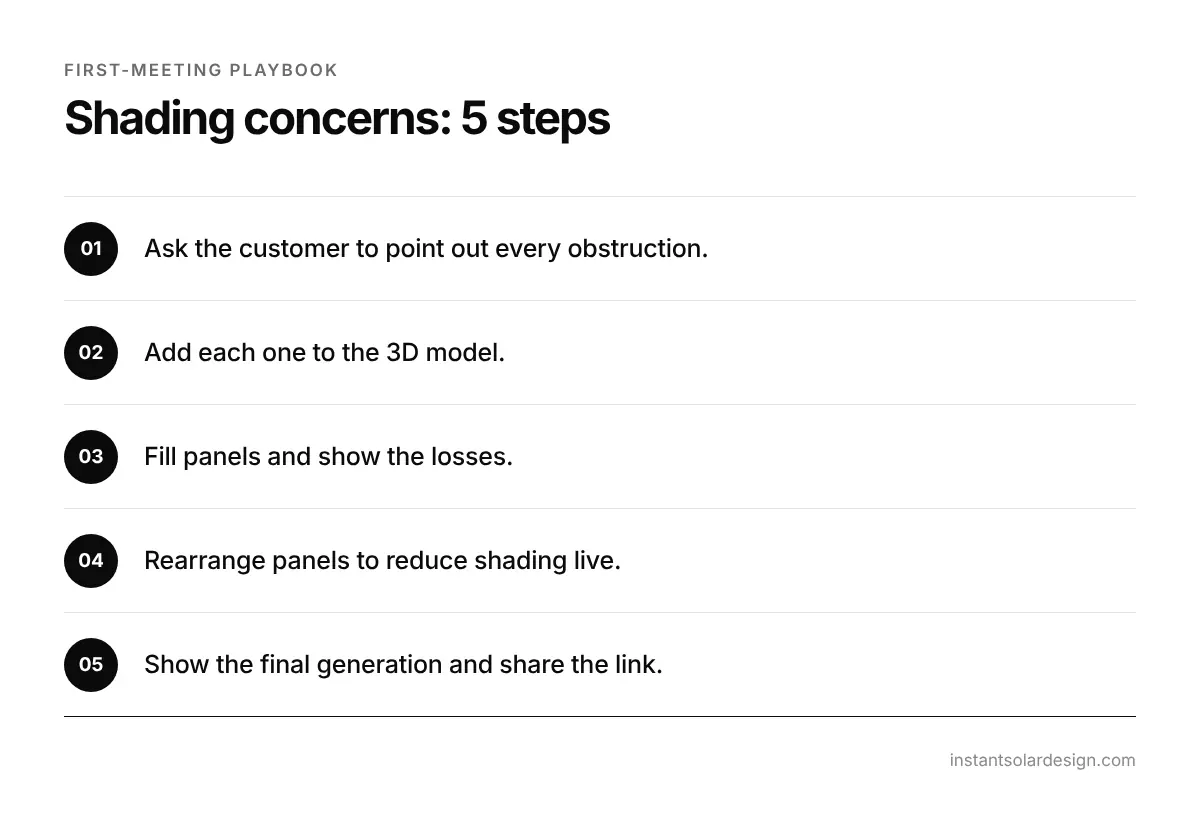
First-meeting playbook: 5 steps
- Ask the customer to point out every obstruction.
- Add each one to the 3D model.
- Fill panels and show the losses.
- Rearrange panels to reduce shading live.
- Show the final generation and share the link.
Add obstructions the customer didn’t mention — it proves you’re thorough.
Solar draft vs traditional first meeting
| Traditional first meeting | With a 3D solar draft | |
|---|---|---|
| What the customer sees | Brochure & price list | Their own roof in 3D |
| Energy estimate | Rule of thumb | Energy report with losses |
| Proposal | Sent 2–3 days later | Built in the meeting |
| Absent decision makers | Hear it second-hand | Open the 3D link |
| Typical outcome | “Let me think about it” | Decision today |
Related reading
- The complete first-meeting playbook for solar EPCs
- Customers Don’t Believe Your Solar Savings? Build Trust in the First Meeting with a Transparent Solar Draft
- “Will It Fit on My Roof?” Answer Roof-Space Doubts Instantly with a 3D Solar Draft
- Best Solar Design Software in India (2026): SolarDraft, Solar Designer, Arka360, SolarLadder, Reslink & SurgePV Compared
Need the design done for you?
Send the site — get a 3D design back in 24 hours.
Instant Solar Design delivers white-labelled 3D models, shadow analysis and generation reports from ₹500 per project.
Order a design →Frequently asked questions
Can shading ruin a solar system?
Heavy shading can significantly reduce generation, which is why obstructions must be modelled during design.
Which obstructions should a shading study include?
Trees, stair rooms (mumty), elevated roofs, water tanks, HVAC units, parapets and neighbouring buildings.
Can I redesign around shading in the meeting?
Yes — move panels and see the loss calculation update.